
Showing posts with label mileage. Show all posts
Showing posts with label mileage. Show all posts
Tuesday, March 8, 2016
It's Been A Quiet Winter
Between house projects (new kitchen) and other car projects, I haven't been able to tackle any of the projects I'd hoped to.
Thankfully, gas is cheap since Ringo is slurping it up like crazy. I'd really love to try harder to improve on the 16 mpg he's been providing as my daily-driver, but I don't have time. If he weren't so reliable, things might be different. But he gets me to and from work without issue, so I just leave well enough alone.

Friday, November 13, 2015
Is It Nearly Thanksgiving Already?

Where does the time go? Two weekends away make for very short weeks. Ringo has been patiently waiting for his turn at daily-driver-ship. This morning that opportunity came and he rewarded my trust with an event-less drive. He’s now been placed in permanent rotation – at least until he finds a new owner. There are still a couple issues I’d like to resolve in the near future. First, the TEMP/PRES light does not illuminate (I’m hoping it’s just a bad bulb). Second, the recently replaced ignition still doesn’t reliably energize the starter. In fact, the last few times I’ve had to use the hotwire in the engine compartment to get the engine going. Fortunately that works every time. I’m not sure if it’s the solenoid since it works if it sees voltage directly from the battery. I measure the voltage at the purple wire connector and got more than 12 volts with no load. I guess I should try and measure voltage when I’m attempting to energize the starter and see if there’s an issue with the replacement ignition switch showing a high resistance.
Glinda is still performing satisfactorily. I put 10 gallons of gas into the tank yesterday and fuelly.com indicated she’d gotten 18 mpg since the last fill up. No long distance trips, hence the drop in mileage from 19+.
Friday, September 25, 2015
Okay, I’ll Break The Silence
By my lack of posts over the last few weeks, one can surmise not much is going on with the fleet. Glinda is still reliably motoring down the road getting her 17.5 mpg as my mostly daily-driver. The guy that modified the racing carburetors for me has agreed to exchange the bases of these apparently faulty ones for new modified ones at no charge, but I still need to tear down the ones I’ve got and ship them off to him before new bases will be sent to me. Today I scored two nearly new bucket seats out of Chevy Cobalt. I’d been watching for these during my sporadic visits to Crazy Ray’s and today I found them. The serendipitous part of this find was that someone had recently removed them from the car and just left them sitting on the ground. It was like I’d called ahead and ordered them. While these seats are not as form-fitting as the racing seats I’ve got, they are much more comfortable and far more practical for a daily-driver. Now I’ll sell the two racing seats and hopefully make back most of the $65 I just spent. Permanently installing these two buckets is already on this winter’s to-do list.

Ringo has gotten some attention too. I’ve sanded the Bondo and applied a few coats of sandable primer. I’ve remounted the right rear wheel and attempted to start the car. Even though the batter shows a good voltage, he won’t crank. I need to clean the terminals before he can be fired up. Last Sunday I hosted an informal gathering of Corvairs. I’d been e-mailing and talking with two new owners and invited them to stop by Sunday after lunch. I also sent out a group e-mail to all the Baltimore club members as well as a Facebook invite. The two new owners showed up (one brought along his enthusiastic wife) and one of the Baltimore owners joined us. We had a great time looking over cars, talking about Corvairs, and getting to know each other.
This gathering (even with its lack of Baltimorean attendance) has prompted me to organize a driving tour for next month. I’ve mapped out a convoluted route on country roads between a Maryland cidery (just south of Frederick), and three northern Virginia wineries. In addition to inviting the Baltimore folks, I’m going to put out the word to the Northern Virginia Corvair Club to see if some of them want to join in.
Ringo has gotten some attention too. I’ve sanded the Bondo and applied a few coats of sandable primer. I’ve remounted the right rear wheel and attempted to start the car. Even though the batter shows a good voltage, he won’t crank. I need to clean the terminals before he can be fired up. Last Sunday I hosted an informal gathering of Corvairs. I’d been e-mailing and talking with two new owners and invited them to stop by Sunday after lunch. I also sent out a group e-mail to all the Baltimore club members as well as a Facebook invite. The two new owners showed up (one brought along his enthusiastic wife) and one of the Baltimore owners joined us. We had a great time looking over cars, talking about Corvairs, and getting to know each other.
This gathering (even with its lack of Baltimorean attendance) has prompted me to organize a driving tour for next month. I’ve mapped out a convoluted route on country roads between a Maryland cidery (just south of Frederick), and three northern Virginia wineries. In addition to inviting the Baltimore folks, I’m going to put out the word to the Northern Virginia Corvair Club to see if some of them want to join in.
Friday, July 17, 2015
Ninety-nine Percent Positive
The other day, as I previously posted, I swapped out Glinda’s modified carburetors for the newly rebuilt ones that were meant for Scarlett. Since that change, she’s been running wonderfully for Mikhaila’s in-town trips. Yesterday morning I couldn’t resist claiming Glinda as my day’s ride. During my brief test drive of a couple weeks back (right after swapping carbs), I could tell that the throttle response was significantly better, but it still a thrill as I headed down the beltway’s on-ramp, transmission in third and pedal to the metal. The tachometer climbed above 4000 rpm with no hesitation and very little needle jiggling. A shift into fourth gear and back to WOT and soon after I was going eighty. What a huge difference. Later that day I pulled into a gas station and put less than seven gallons of high-test into the tank. According to fuelly.com Glinda had averaged over 17 mpg since the carb swap - where she’d been before the swap.

When I got home, I pulled the #1 and #6 plugs and checked them for fouling – nice and clean tip and ground electrode. #1 looked clean all over, while #6 had a little black buildup around the face of the plug body. I didn’t clean them, but put them right back in and will check again after another couple hundred miles. If, after that, the mileage is still good and the plugs are still clean, I’ll be asking the source of the modified carburetors to replace them. I’ll also, at some point, put back the Pertronix Ignitor and coil since they weren’t causing the rough-running.

When I got home, I pulled the #1 and #6 plugs and checked them for fouling – nice and clean tip and ground electrode. #1 looked clean all over, while #6 had a little black buildup around the face of the plug body. I didn’t clean them, but put them right back in and will check again after another couple hundred miles. If, after that, the mileage is still good and the plugs are still clean, I’ll be asking the source of the modified carburetors to replace them. I’ll also, at some point, put back the Pertronix Ignitor and coil since they weren’t causing the rough-running.
Monday, July 6, 2015
Three Cars, Three Updates
Glinda: No Racer No More
A couple weeks ago I hopped into Glinda for a quick evening drive. I started her up, and pulled away from the curb. Since it had been raining, I turned the wiper knob to clear the windshield, but nothing happened - at least nothing wiper-wise. Some other things DID happen though. The radio shut off, the tach needle went to zero, and so did the voltmeter. I immediately turned off the wiper switch and everything went back to working. Since I didn’t want to get stuck somewhere, I pulled her back to the curb, with the intent of dealing with the problem later. The following morning, before turning on the car, I pushed in the wiper switch rather than turned it as a test – the wipers worked as normal. I turned them off, and, thinking the previous evening’s gremlin had moved on, I started the car and drove away. A few moments later, I checked Glinda gauges and found the voltage sitting at 10.8 rather than the normal 14+. Not having a spare vehicle available to me this morning, I continued on to work minimizing my use of electrical stuff. By the time I pulled into my parking spot at work, the gauge was now reading about 10.2. I shut off the car, and then turned the key to the ON position – the gauge needle was now pointing at slightly above 12. The drive home, however, was business as usual. The voltmeter needle pointed back to where I was used to seeing and all seemed fine.
The lovely Loriann and I decided that Mikhaila needed a car to drive while waiting for us to finish Scarlett. Glinda drew the short straw. To facilitate Glinda’s new duties, Mikhaila and I swapped out the racing seat and harness for the stock bench and belts, and we put back the skinny tires in place of the wide racing wheels. I rode with Mikhaila giving out instructions as she wheeled the car around the neighborhood. She did quite well getting used to the heavier steering and relearning the manual transmission skills she’d not had to put into practice for months.
Yesterday, after recording another tank-full of atrocious gas mileage, I gave up on the modified carburetors and swapped on Scarlett’s pair. With the recently rebuilt carbs hooked up and some gas poured down each throat, the engine reluctantly fired. After a few moments, gas started squirting out of the vent holes of the right carb. Off went the engine and off came that carb top, but not until I checked the accelerator pumps – no squirts in either carb. Inspecting the removed top assembly, I found that the wire needle retainer was preventing the needle from easily seating itself. So, I removed and re-set the float levels to ’65 setting (1-1/16” full up and 1-1/2” for full drop). I then dug out some new accelerator pump cups and a couple GUP pump assemblies from my stash. I found that the two assemblies both had pliant cups that worked perfectly in their associated bores, so one went on in place of the right top’s non-functioning one. After reinstalling that side, I pulled the left top assembly off made the same changes. Next, I needed to again clean all the filthy, fouled spark plugs (this is getting old). With everything installed and connected back up, jumping 12 volts to the purple wire contact got the engine running right away. No gushing gas and blips of the throttle were met with immediate rpm responses from the engine. I climbed in, belted up, and took her for a spin around the neighborhood. She ran better than she had in months – coincidentally the same number of months the racing carburetors had been on the engine.
Needless to say, I was quite happy as I backed her up to the garage opening. I got out my length of clear tubing, shot some water in, hooked both ends up to the appropriate vacuum ports, and balanced the carbs. With the air cleaner back on, I adjusted the idle fuel screws per the manual before setting the idle speed to 800 and shutting the engine lid convinced all woes with that car were now behind me. That euphoria lasted less than twenty-four hours ended by a single text from Mikhaila: “Glinda keeps stalling and the gas gauge went from full this morning to half full when I ran an errand.” CRAP! I thought I’d get to work on the house this evening, but NO!
Scarlett Brakes Won’t Bleed
During the last week Mikhaila and I have had a couple productive sessions in the garage. Scarlett now has all her new brake lines in place as well as her exhaust system completely hooked up. With the last brake line fitting tightened, she and I spent at least an hour and went through over a pint of brake fluid trying to get a solid pedal. With all the components of the system being new, there was a lot of air that had to be bled out. After running out of fluid, we were still getting air with each opening of a bleeder valve. Part way through the task, I got smart and adjusted the pedal rod making it longer so it would push the pistons in the new dual master cylinder deeper. This seemed to get more fluid pushed out with each stroke. I hope we’re right around the corner from an air-free system.
The muffler hanger arrived in the mail Saturday morning, so we bolted it to the engine. A new strap held the GUP muffler in place and a new 2” muffler clamp solidified the exhaust pipe to muffler joint. The engine is ready to start up other than the fact that 1) I took the carbs for Glinda, and 2) I put battery back in Ringo (see more below).
Mikhaila also took advantage of the seats being out and more thoroughly scrubbed the years of dirt from each of the front bucket seats. We also stripped the old rear window material from the three trim sticks in preparation of a new top getting installed (a ways off from happening).
Ringo Readies for Upcoming Sale

Yesterday, I pulled the tarp off Ringo with the intent of deciding what I would do to this car before I put it on the market. Instead, I jumped right into the fray by swapping back in the battery he’d so graciously loaned to Scarlett. A bit of gas poured into each carburetor and a few revolutions of the engine by the starter and the engine was running smoothly like he’d been on the road a week ago not a year ago. Next on the checklist was bodywork made necessary by the destructive right rear tire. I bent and pounded the sheetmetal behind the wheel into some semblance of its original shape. Grabbing the grinder fitted with the wire brush attachment, I attacked the mess along the front edge of the wheel-well as well as the inside of the wheel-well (is that too many wells?). I also brushed away the flaking paint and surface rust on straightened out section. Next, I pulled a jar of rusty metal primer and brushed over all the exposed steel.
I remembered that the last time I’d seen Ariel drive away in this car, one of the rear taillights wasn’t working. It took some cleaning and bulb replacement, but after a half-hour or so I had all essential lights operating properly.
With all this progress, I decided I’d move him out into the middle of the driveway so I could access the stuck driver’s door. I climbed behind the wheel, put my foot on the brake pedal, and it went all the way to the floor. I climbed back out, popped the trunklid, spun off the master cylinder cap, and stared down into an empty master cylinder reservoir. Hoping against all hope I filled the reservoir with fresh fluid and crossed my fingers. Maybe, I though, the seals will magically rejuvenate themselves after a good soaking with DOT 3.
This morning though, I went ahead and made the call to the Corvair Ranch and ordered a rebuild kit. I also asked Jeff to send me a Powerglide re-seal kit, two carburetor rebuild kits (so I rebuild the two EM carbs on the shelf to put on Scarlett’s engine), and a muffler strap for Glinda.
A couple weeks ago I hopped into Glinda for a quick evening drive. I started her up, and pulled away from the curb. Since it had been raining, I turned the wiper knob to clear the windshield, but nothing happened - at least nothing wiper-wise. Some other things DID happen though. The radio shut off, the tach needle went to zero, and so did the voltmeter. I immediately turned off the wiper switch and everything went back to working. Since I didn’t want to get stuck somewhere, I pulled her back to the curb, with the intent of dealing with the problem later. The following morning, before turning on the car, I pushed in the wiper switch rather than turned it as a test – the wipers worked as normal. I turned them off, and, thinking the previous evening’s gremlin had moved on, I started the car and drove away. A few moments later, I checked Glinda gauges and found the voltage sitting at 10.8 rather than the normal 14+. Not having a spare vehicle available to me this morning, I continued on to work minimizing my use of electrical stuff. By the time I pulled into my parking spot at work, the gauge was now reading about 10.2. I shut off the car, and then turned the key to the ON position – the gauge needle was now pointing at slightly above 12. The drive home, however, was business as usual. The voltmeter needle pointed back to where I was used to seeing and all seemed fine.
The lovely Loriann and I decided that Mikhaila needed a car to drive while waiting for us to finish Scarlett. Glinda drew the short straw. To facilitate Glinda’s new duties, Mikhaila and I swapped out the racing seat and harness for the stock bench and belts, and we put back the skinny tires in place of the wide racing wheels. I rode with Mikhaila giving out instructions as she wheeled the car around the neighborhood. She did quite well getting used to the heavier steering and relearning the manual transmission skills she’d not had to put into practice for months.
Yesterday, after recording another tank-full of atrocious gas mileage, I gave up on the modified carburetors and swapped on Scarlett’s pair. With the recently rebuilt carbs hooked up and some gas poured down each throat, the engine reluctantly fired. After a few moments, gas started squirting out of the vent holes of the right carb. Off went the engine and off came that carb top, but not until I checked the accelerator pumps – no squirts in either carb. Inspecting the removed top assembly, I found that the wire needle retainer was preventing the needle from easily seating itself. So, I removed and re-set the float levels to ’65 setting (1-1/16” full up and 1-1/2” for full drop). I then dug out some new accelerator pump cups and a couple GUP pump assemblies from my stash. I found that the two assemblies both had pliant cups that worked perfectly in their associated bores, so one went on in place of the right top’s non-functioning one. After reinstalling that side, I pulled the left top assembly off made the same changes. Next, I needed to again clean all the filthy, fouled spark plugs (this is getting old). With everything installed and connected back up, jumping 12 volts to the purple wire contact got the engine running right away. No gushing gas and blips of the throttle were met with immediate rpm responses from the engine. I climbed in, belted up, and took her for a spin around the neighborhood. She ran better than she had in months – coincidentally the same number of months the racing carburetors had been on the engine.
Needless to say, I was quite happy as I backed her up to the garage opening. I got out my length of clear tubing, shot some water in, hooked both ends up to the appropriate vacuum ports, and balanced the carbs. With the air cleaner back on, I adjusted the idle fuel screws per the manual before setting the idle speed to 800 and shutting the engine lid convinced all woes with that car were now behind me. That euphoria lasted less than twenty-four hours ended by a single text from Mikhaila: “Glinda keeps stalling and the gas gauge went from full this morning to half full when I ran an errand.” CRAP! I thought I’d get to work on the house this evening, but NO!
Scarlett Brakes Won’t Bleed
During the last week Mikhaila and I have had a couple productive sessions in the garage. Scarlett now has all her new brake lines in place as well as her exhaust system completely hooked up. With the last brake line fitting tightened, she and I spent at least an hour and went through over a pint of brake fluid trying to get a solid pedal. With all the components of the system being new, there was a lot of air that had to be bled out. After running out of fluid, we were still getting air with each opening of a bleeder valve. Part way through the task, I got smart and adjusted the pedal rod making it longer so it would push the pistons in the new dual master cylinder deeper. This seemed to get more fluid pushed out with each stroke. I hope we’re right around the corner from an air-free system.
The muffler hanger arrived in the mail Saturday morning, so we bolted it to the engine. A new strap held the GUP muffler in place and a new 2” muffler clamp solidified the exhaust pipe to muffler joint. The engine is ready to start up other than the fact that 1) I took the carbs for Glinda, and 2) I put battery back in Ringo (see more below).
Mikhaila also took advantage of the seats being out and more thoroughly scrubbed the years of dirt from each of the front bucket seats. We also stripped the old rear window material from the three trim sticks in preparation of a new top getting installed (a ways off from happening).
Ringo Readies for Upcoming Sale

Yesterday, I pulled the tarp off Ringo with the intent of deciding what I would do to this car before I put it on the market. Instead, I jumped right into the fray by swapping back in the battery he’d so graciously loaned to Scarlett. A bit of gas poured into each carburetor and a few revolutions of the engine by the starter and the engine was running smoothly like he’d been on the road a week ago not a year ago. Next on the checklist was bodywork made necessary by the destructive right rear tire. I bent and pounded the sheetmetal behind the wheel into some semblance of its original shape. Grabbing the grinder fitted with the wire brush attachment, I attacked the mess along the front edge of the wheel-well as well as the inside of the wheel-well (is that too many wells?). I also brushed away the flaking paint and surface rust on straightened out section. Next, I pulled a jar of rusty metal primer and brushed over all the exposed steel.
I remembered that the last time I’d seen Ariel drive away in this car, one of the rear taillights wasn’t working. It took some cleaning and bulb replacement, but after a half-hour or so I had all essential lights operating properly.
With all this progress, I decided I’d move him out into the middle of the driveway so I could access the stuck driver’s door. I climbed behind the wheel, put my foot on the brake pedal, and it went all the way to the floor. I climbed back out, popped the trunklid, spun off the master cylinder cap, and stared down into an empty master cylinder reservoir. Hoping against all hope I filled the reservoir with fresh fluid and crossed my fingers. Maybe, I though, the seals will magically rejuvenate themselves after a good soaking with DOT 3.
This morning though, I went ahead and made the call to the Corvair Ranch and ordered a rebuild kit. I also asked Jeff to send me a Powerglide re-seal kit, two carburetor rebuild kits (so I rebuild the two EM carbs on the shelf to put on Scarlett’s engine), and a muffler strap for Glinda.
Thursday, June 4, 2015
A Success Of Sorts
While I was driving Glinda home from work yesterday, I noticed the tachometer needle would jump up while accelerating (even slight acceleration). The needle jumps up a few hundred rpm and then quickly falls back. It happened quite frequently and it appeared to have a slight miss when it did it. Soon after arriving home, I grabbed my tablet and posted my problem on Virtual Vairs. Within minutes, I received a reply from Mark Durham positing a faulty points plate. As soon as dinner was over, I donned grungies and headed out to the driveway where Glinda awaited.
Diving into the distributor, I pulled the plate and confirmed it was unmodified – no provisions to improve grounding. Ringo gave up his points plate – one that a ‘vair vendor had modified with a wire brush around the pivot to improve grounding. Before installing the replacement plate I cleaned the points with a quick swipe of fine sandpaper. Once the plate was in place, I adjusted the dwell to 32 degrees, put the rest of the distributor together, and set the timing to 16 degrees BTDC.
The subsequent test drive showed smooth action by the tach needle – success. There was still some hesitation under WOT at higher rpms in third gear. It wasn’t until this morning’s commute that I could check out the performance in fourth gear. There's still hesitation in fourth gear preventing me from getting much above four grand in the short bursts available to me.
Also somewhat disconcerting is the steady drop of the fuel gauge needle. Granted I’m doing a lot of WOT runs, but I’m still thinking the engine’s running rich. While I’ll be taking a pair of carburetors with me to New York, it’s doubtful I’ll do the swap until after the weekend.
Diving into the distributor, I pulled the plate and confirmed it was unmodified – no provisions to improve grounding. Ringo gave up his points plate – one that a ‘vair vendor had modified with a wire brush around the pivot to improve grounding. Before installing the replacement plate I cleaned the points with a quick swipe of fine sandpaper. Once the plate was in place, I adjusted the dwell to 32 degrees, put the rest of the distributor together, and set the timing to 16 degrees BTDC.
The subsequent test drive showed smooth action by the tach needle – success. There was still some hesitation under WOT at higher rpms in third gear. It wasn’t until this morning’s commute that I could check out the performance in fourth gear. There's still hesitation in fourth gear preventing me from getting much above four grand in the short bursts available to me.
Also somewhat disconcerting is the steady drop of the fuel gauge needle. Granted I’m doing a lot of WOT runs, but I’m still thinking the engine’s running rich. While I’ll be taking a pair of carburetors with me to New York, it’s doubtful I’ll do the swap until after the weekend.
Wednesday, June 3, 2015
Better, But Not Great
Going against the best evidence (crappy gas mileage, sooty spark plugs), I decided I’d focus on ignition (Ignitor II) over the fuel (rich carburetors).
Last night I backed Glinda up to the open garage door with the intention of reverting back to stock points to see if the poor performance can be remedied. After removing the distributor cap, rotor, and dust cover, I took out the two screws holding the Ignitor II in place, and zip-tied it out of the way. The stock points plate took its place and the rest of the distributor assembly was buttoned up. I borrowed the new-looking coil from Scarlett and zip-tied it to the engine for temporary testing purposes. With the leads in place, I fired up the engine and checked the timing. Since it was close to twelve degrees BTDC, I called it good enough for my purposes.
The subsequent test drive indicated the engine would pull in first and second gears without hesitation. Problem solved. Back to the driveway.
I removed and stored the Ignitor II and Flame-thrower coil and bolted the stock coil into place. After re-hooking up the wiring, I shut the engine lid and went inside for dinner.
This morning, once on the highway, I did a few WOT runs in 4th. Sadly, all was not well. As the rpms went up, the tach needle started occasionally bouncing around and the engine didn't seem to be pulling as hard. I was, however, able to get up to around 4000 rpm, but not much more. I still need to check the plugs (sooty or not) and tweak the timing, but I'm disappointed. I'll be taking different carburetors with me to the track. I don't want to swap carbs while at the track, but I'll try anything now.
Last night I backed Glinda up to the open garage door with the intention of reverting back to stock points to see if the poor performance can be remedied. After removing the distributor cap, rotor, and dust cover, I took out the two screws holding the Ignitor II in place, and zip-tied it out of the way. The stock points plate took its place and the rest of the distributor assembly was buttoned up. I borrowed the new-looking coil from Scarlett and zip-tied it to the engine for temporary testing purposes. With the leads in place, I fired up the engine and checked the timing. Since it was close to twelve degrees BTDC, I called it good enough for my purposes.
The subsequent test drive indicated the engine would pull in first and second gears without hesitation. Problem solved. Back to the driveway.
I removed and stored the Ignitor II and Flame-thrower coil and bolted the stock coil into place. After re-hooking up the wiring, I shut the engine lid and went inside for dinner.
This morning, once on the highway, I did a few WOT runs in 4th. Sadly, all was not well. As the rpms went up, the tach needle started occasionally bouncing around and the engine didn't seem to be pulling as hard. I was, however, able to get up to around 4000 rpm, but not much more. I still need to check the plugs (sooty or not) and tweak the timing, but I'm disappointed. I'll be taking different carburetors with me to the track. I don't want to swap carbs while at the track, but I'll try anything now.
Monday, June 1, 2015
A Fork In The Road
Saturday morning I was out in the driveway early attacking Glinda’s carburetors. I pulled the right one off the engine first. A hex wrench twisted out the plug giving me access to remove the jet. Once out, I could read the “52” stamped on the head. I’d thought I’d see a “53”. Knowing I needed to make a significant change, I screwed in a #50 jet, reinstalled the plug with some pipe sealant, and placed the carb base back on then engine. The same operations were performed on the other carb before pouring some gas into both bases. The the lids in place and the linkage all connected, I turned the key and the engine started right up and settled into a 600 rpm loping idle. Throttle response seemed acceptable with each blip of the throttle, so I left the engine running while I lowered the front end off the jackstands. Unusually, the driveway was clear, so I rolled Glinda off the ramps and out onto the street for a quick spin around the neighborhood. Sadly, the wide-open-throttle performance is still lacking – won’t pull strongly above 3500 rpm. I’ve driven the car a few times since (about 40 miles) and the gas gauge needle is already indicating I’ve burned about 4 gallons. Easy to do the math to see that estimated ten miles per gallon isn’t acceptable.
What to do now? I could still try to go against my belief that the carburetors are to blame and focus on the ignition. That would mean swapping out the used Ignitor II and new Flamethrower coil for the stock points and an old coil – roughly an hour of my time. Or I could go with all the evidence and replace the modified carbs with either Ringo’s proven ones or Scarlett’s recently rebuilt ones – again about an hour of work. Neither of the replacement sets of carbs have had the jets relocated. If the swap cures the mileage and WOT issues, I’ll still be faced with fuel cutout after high speed turns – and there are seven of them at the track I’m heading to in a few days. With rain in the forecast for this evening, I’ve got another day to make the decision.
What to do now? I could still try to go against my belief that the carburetors are to blame and focus on the ignition. That would mean swapping out the used Ignitor II and new Flamethrower coil for the stock points and an old coil – roughly an hour of my time. Or I could go with all the evidence and replace the modified carbs with either Ringo’s proven ones or Scarlett’s recently rebuilt ones – again about an hour of work. Neither of the replacement sets of carbs have had the jets relocated. If the swap cures the mileage and WOT issues, I’ll still be faced with fuel cutout after high speed turns – and there are seven of them at the track I’m heading to in a few days. With rain in the forecast for this evening, I’ve got another day to make the decision.
Monday, May 11, 2015
The Jury’s Out
Only had a couple hours during this last, very busy weekend to work on cars. Saturday morning I got Mikhaila out to the garage for some Scarlett-time before she had to go to work. We wanted to verify that Scarlett’s distributor and coil would play together and make sparks. First, we borrowed Ringo’s battery, hooked it up, and spun the engine to get the timing mark lined up with the 8 degree BTDC mark. We then checked to see if the distributor’s rotor was pointing to the #1 plug post. It wasn’t so we pulled the distributor out, twisted its shaft a few degrees, and then twisted the oil pump shaft the same amount, and poked the distributor back in place. After installing the new spark plug cables, Mikhaila hooked up the timing light. With the key on, I spun the distributor while she held the light’s trigger closed and watched for a light – nothing. At that point she had to leave, but I wasn’t ready to quit. I got out the feeler gauges and set the point gap to .016 inch. I twisted the distributor with the cap off and could see sparks each the points opened. When I was happy with the location of the distributor, I tightened the hold-clamp nut and turned off the key.
With a little time left before having to get ready for date night with the lovely Loriann, I grabbed tools and headed to the curb where Glinda was waiting to have the floats in her carbs adjusted. The last fill up showed she was only getting a little over 14 mpg, and that would not do for a daily-driver that demands high-octane. I pulled the cover off each cover and re-set each float to be parallel at needle closed position (about 1 1/4” measures) and 1 3/4” at full drop. With everything back together I took her for a spin around the neighborhood – still a nice throttle response. Hopefully, this will get her mileage back into the high-teens. I drove the truck this morning, but plan on putting the miles on Glinda during the rest of the week.
With a little time left before having to get ready for date night with the lovely Loriann, I grabbed tools and headed to the curb where Glinda was waiting to have the floats in her carbs adjusted. The last fill up showed she was only getting a little over 14 mpg, and that would not do for a daily-driver that demands high-octane. I pulled the cover off each cover and re-set each float to be parallel at needle closed position (about 1 1/4” measures) and 1 3/4” at full drop. With everything back together I took her for a spin around the neighborhood – still a nice throttle response. Hopefully, this will get her mileage back into the high-teens. I drove the truck this morning, but plan on putting the miles on Glinda during the rest of the week.
Friday, May 8, 2015
Glinda Update
I’ve been driving Glinda nearly every day this week. The clutch clunking is an on again off again thing. Some mornings it’s there with the first press of the pedal. Other times it only appears once the engine’s hot. It only seems to be there upon pulling away. I can’t feel it on the 1-2, 2-3, etc. shifts. Odd. Like I told the lovely Loriann, “I’m driving it until something breaks.” I had a friend recommend I buy a cheap boroscope from my favorite toy store (Harbor Freight) and watch the throwout bearing/pressure plate. I may do that if it gets worse.
While I can live with clutch clunking, I can’t afford to live with 12 miles to the gallon. That’s what I estimate she’s currently getting. I’m not driving pedal to the metal either. Just a few blasts through the gears to makes sure the stumbling is still gone, but, other than that, it’s relatively sedate driving. By the end of this weekend I will have increased each carb’s float height at least an 1/8th of an inch from where it’s at. This to make the carbs run leaner. I wanted to also replace the #53 jets with #50s, but a smarter person (the lovely Loriann) recommended I just do one change at a time and do the easier one first.
Other than that, the car seems to be behaving.
While I can live with clutch clunking, I can’t afford to live with 12 miles to the gallon. That’s what I estimate she’s currently getting. I’m not driving pedal to the metal either. Just a few blasts through the gears to makes sure the stumbling is still gone, but, other than that, it’s relatively sedate driving. By the end of this weekend I will have increased each carb’s float height at least an 1/8th of an inch from where it’s at. This to make the carbs run leaner. I wanted to also replace the #53 jets with #50s, but a smarter person (the lovely Loriann) recommended I just do one change at a time and do the easier one first.
Other than that, the car seems to be behaving.
Thursday, June 26, 2014
Ungrounded?
The lovely Loriann’s daily-driver had a breakdown the other day, so while I wait for parts, she’s driving the truck, and I’m behind the wheel of Glinda. Swapping the right-side carb from Ringo onto Glinda (replacing the one with a noticeably higher fuel level) has pretty much erased the quick-throttle bogging issue. With that problem solved, it’s been difficult not to use the loud pedal more exuberantly. With that, I’m not sure I’m doing my fuel mileage test any good.
It appears that I’ve messed up the grounding of the dashboard when I was installing the new clutch and brake pedals. I first noticed that the wiper switch wasn’t working, and then the fuel gauge is now stuck on E. Monday evening I tried finding the disconnected, wayward wire, but struck out. After some web research, I found the ground strap in an assembly diagram, so that’ll be my next inspection point.
Of course it could also be a coincidental failure of both items, but I deeply doubt it.
It appears that I’ve messed up the grounding of the dashboard when I was installing the new clutch and brake pedals. I first noticed that the wiper switch wasn’t working, and then the fuel gauge is now stuck on E. Monday evening I tried finding the disconnected, wayward wire, but struck out. After some web research, I found the ground strap in an assembly diagram, so that’ll be my next inspection point.
Of course it could also be a coincidental failure of both items, but I deeply doubt it.
Monday, June 9, 2014
I Am So Frustrated
All is not rosey with the fleet right now. No work has commenced on Scarlett, Victoria is uninspired to work on Luna, Glinda’s fuel mileage woes continue, and Ariel just reported that Ringo’s driver’s door won’t open. Argh!
As mentioned, Glinda’s mileage keeps dropping (we’re down to less than 11 mpg), but I still can’t find why. While it does look (slightly sooty tail pipe) and smell like her engine is running rich, I find it hard to believe that the #52 jets are responsible. These are the same jets that, on the stock carburetors, gave nearly 20 mpg, but on these rebuilt ’66 vintage carbs the mileage keeps dropping. It’s that last bit of information that makes me believe something is leaking and the leak is getting worse. I need to find the source of that leak and fix it. Regardless, I still need to swap in the smaller #51 jets I got from the Corvair Ranch to treat the bogging under quick throttle issue.
It appears I’ll be buying a used door latch from the Ranch and installing it in Ringo’s inoperable door. That won’t be fun. At least it failed in the closed position. Ariel says she’ll finally be a serious car shopper come early July.
As mentioned, Glinda’s mileage keeps dropping (we’re down to less than 11 mpg), but I still can’t find why. While it does look (slightly sooty tail pipe) and smell like her engine is running rich, I find it hard to believe that the #52 jets are responsible. These are the same jets that, on the stock carburetors, gave nearly 20 mpg, but on these rebuilt ’66 vintage carbs the mileage keeps dropping. It’s that last bit of information that makes me believe something is leaking and the leak is getting worse. I need to find the source of that leak and fix it. Regardless, I still need to swap in the smaller #51 jets I got from the Corvair Ranch to treat the bogging under quick throttle issue.
It appears I’ll be buying a used door latch from the Ranch and installing it in Ringo’s inoperable door. That won’t be fun. At least it failed in the closed position. Ariel says she’ll finally be a serious car shopper come early July.
Monday, March 10, 2014
Yes, Progress Was Made

Can I say that my winter of discontent is gone? Not quite, but the light at the end of the tunnel went from a hazy blur to a noticeable circle. Saturday had the beautiful weather that was predicted so working in the driveway was pleasurable. Attempting to stick to my to-do list of Friday’s post, I started by installing the pressure gauge using some 3/8” fuel hose, and a spare fuel pump nipple. With the engine idling the current fuel pump (call it pump #1) showed a reading of 10 psi (remember stock is 3-4). I was giddy with joy over this failure. It appeared that I’d found the source of Glinda’ horrendously low fuel mileage. Not to fix the failure. With two GUP pumps on the shelf, I decided to see if either of them has the right output before I popped open pump #1. Well, pump #2 was only slightly better at 9 psi, while pump #3 was the Arnold Schwarzenegger of fuel pumps with a reading of 14 psi. Not wanting to un-mount a pump again, I removed the five small cap screws holding the pump sandwich together, cut off about a half coil from the internal spring, and reassembled the pump. That brought the pressure down to about 12. It took five more disassemble/cut the spring/reassemble/test cycles before I got the pressure down to just a hair above 4 psi. In the end, I’d removed about two coils from the spring leaving only four. I didn’t have a chance to do a test drive to see if the quick-throttle bogging was gone, but once the rain washes the salt away, I’ll be able to get her back on the road.

The next task on the list was to install the new stereo. That went well, and the tunes that come out of the two six by nines on the package shelf sound awesome! At that point, it was time to knock off for the day.
Sunday afternoon it was Ringo, not Glinda, that kicked off the car-work. Ariel had gone to drive him to church Saturday morning and discovered his left rear tire was almost flat. She limped him over to the house, and I jacked up his left rear, pulled the tire, and quickly found the leak-causing nail. A few minutes later, the nail was out, the hole was plugged, the tire was tested and then re-installed on the car. When I’d gone to Ariel’s work to deal with the broken pin in Ringo’s door, I’d noticed the driver’s door was very difficult to latch. To address that problem, I moved the strike plate as far out as it would go. This made it possible to get the door to latch without slamming it and it doesn’t seem to have affected the fit. TYL.
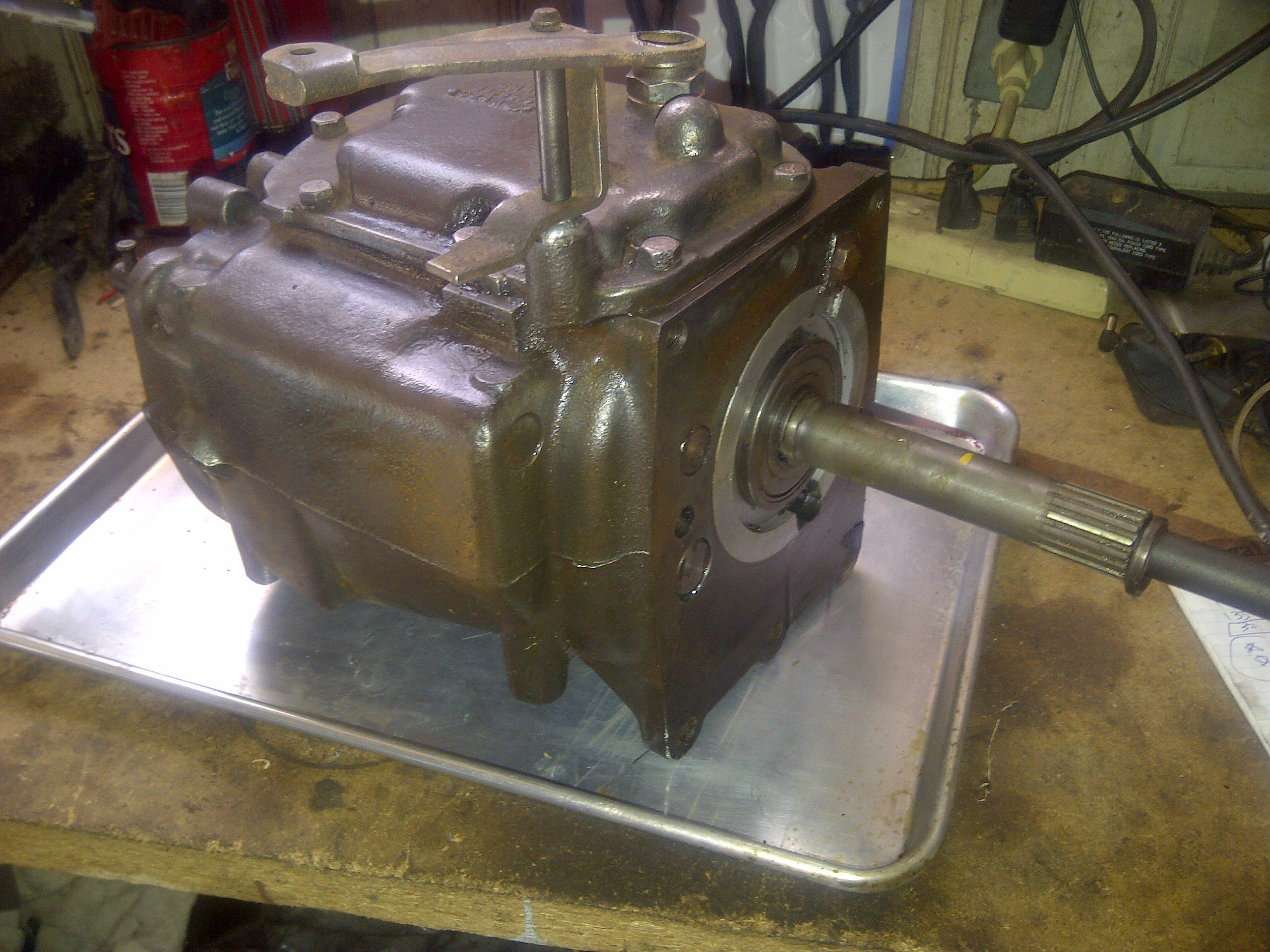
With Ringo roadworthy again, I decided to divert from Glinda’s to-do list and focus on prepping the 4-speed swap parts as opposed to installing the pedal assembly. Out of the portable garage came the transmission and after some quality time on the receiving end of my grinder-mounted wire brush, it looks like something usable. As I was turning the housing around, clear 90 weight oil oozed out the hole in the differential mounting face and it looked clean. I’m not going to mess with the tranny since the optimist in me equates good oil with good transmission – it’s easy that way. Next out onto the grass for a good brushing was a bellhousing that had the letters LM written on it. I’m praying I marked it correctly. It too became clean-looking and was set in the garage for clean storage. I noted that I’ll need to replace the engine seal that is part of the bellhousing. Next I dug out the pressure plate, flywheel, and associated fasteners. The flywheel feels tight, so I’ll be able to replace the rivets with screws without any troubles (fingers-crossed). Finally, I gave a glance at differential that came out of Phil’s Corsa and the broken end of the output shaft reminded me I need get a replacement differential or rebuild this one with a new shaft. I’m going with option number one if I can score a stock open one for less than $100.
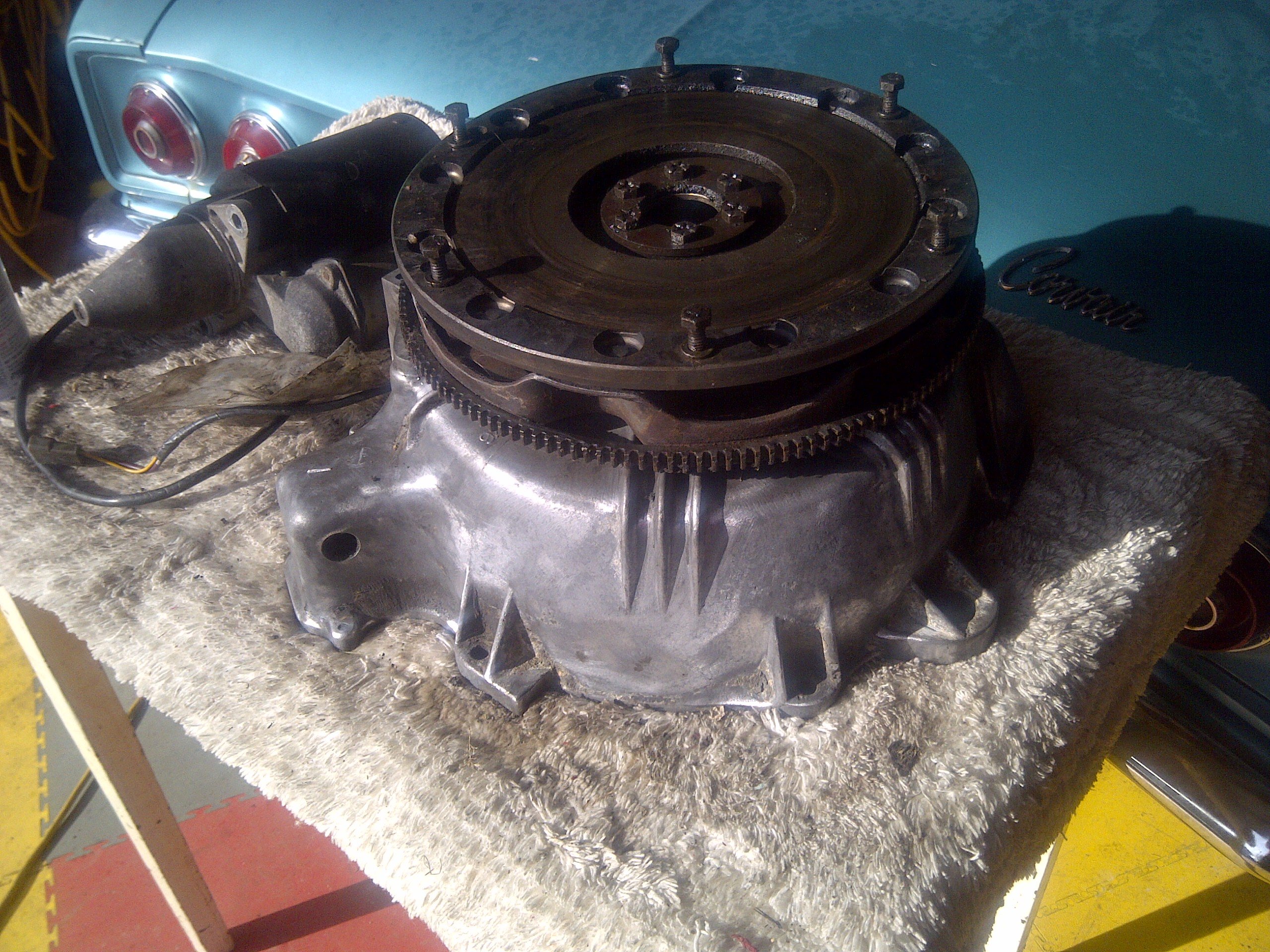
What a joy it was to make some headway in getting Glinda’s transmission swap. There are a lot of work left to do, but I’m confident now that I’ll be able to squeeze it all in before the Memorial Day weekend track day scheduled in New York.
Friday, March 7, 2014
Will It Happen?
Will the winter of my discontent come to an end this weekend? Will Glinda become more than just the object of my rejection? Can I find the source of her gas-hoggedness? Will the 4-speed swap begin? I pray the answer to all these questions will be a resounding yes come Monday. The weather is predicted to be tolerable, there aren’t any house projects scheduled, and Ringo is currently roadworthy (TYL).
With TwoTone in the driveway, Glinda has the place of honor (in the garage). My plan is to start my car-day by checking her fuel pressure. It’s supposed to be 3-4 psi. Anything higher than that will cause the level in the carburetor bowls to be higher, and thus reduce gas mileage. There is a fix to reduce the output pressure of the pump, and that is to shorten the length of the pump’s spring. I’m praying this is the problem, and that the fix goes easily. Next on the agenda is installing the new stereo and speakers that have been sitting on the garage floor for a few months.

Item three is slapping on the IROC wheels and tires I bought at Rich’s parts sale. I posted the following doctored up JPEG on Facebook today to get opinions on how I should colorize the wheels, if at all. For now I’ll put them on plain, but painting the insets of the spokes body color is a leading candidate for change.

Finally, I’ll begin the 4-speed swap by installing the pedal assembly. I won’t care if the third pedal can’t do anything – I’ll just zip tie it out of the way. Hopefully, this will leave me time to gather together all the parts and pieces that I’ve collected for this swap allowing me to determine what I’m missing. Finally, I’ll check the condition of the flywheel. My hope is that it’s in good enough shape for me to replace the unreliable rivets with 7 mm bolts.
Come Monday I’ll report back on what, if anything, I actually accomplished.
With TwoTone in the driveway, Glinda has the place of honor (in the garage). My plan is to start my car-day by checking her fuel pressure. It’s supposed to be 3-4 psi. Anything higher than that will cause the level in the carburetor bowls to be higher, and thus reduce gas mileage. There is a fix to reduce the output pressure of the pump, and that is to shorten the length of the pump’s spring. I’m praying this is the problem, and that the fix goes easily. Next on the agenda is installing the new stereo and speakers that have been sitting on the garage floor for a few months.
Item three is slapping on the IROC wheels and tires I bought at Rich’s parts sale. I posted the following doctored up JPEG on Facebook today to get opinions on how I should colorize the wheels, if at all. For now I’ll put them on plain, but painting the insets of the spokes body color is a leading candidate for change.
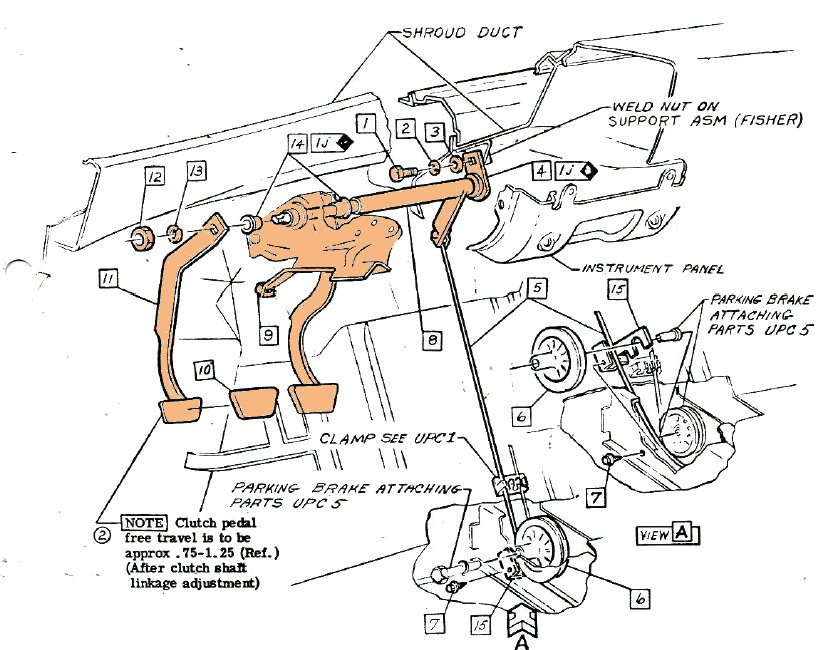
Finally, I’ll begin the 4-speed swap by installing the pedal assembly. I won’t care if the third pedal can’t do anything – I’ll just zip tie it out of the way. Hopefully, this will leave me time to gather together all the parts and pieces that I’ve collected for this swap allowing me to determine what I’m missing. Finally, I’ll check the condition of the flywheel. My hope is that it’s in good enough shape for me to replace the unreliable rivets with 7 mm bolts.
Come Monday I’ll report back on what, if anything, I actually accomplished.
Wednesday, February 26, 2014
Too Much Fuel?
Last Sunday I reinstalled the re-rebuilt carburetors onto Glinda with high hopes that the quick-throttle bogging of the engine would be gone. The reason I could bring myself to this state was that the carburetor that had not been showing an accelerator pump shot miraculously fixed itself. I was going to tear it down on the workbench, but gave the linkage one more blip and lo-and-behold out came a couple squirts of gas from the accelerator pump port.
Anyway, the carb went on, followed by the spark plug leads I’d borrowed for TwoTone’s startup, followed by the air cleaner and spare tire. The engine fired right up and settled into a thousand-rpm high idle. Success!
Or was it? The next morning I drove the car to and from work and sadly watched the gas gauge needle drop nearly an eighth of a tank. Tuesday I drove the thirsty beast again and watched the needle drop below three-quarter tank. Argh!
Maybe the fuel pressure is too high? I ordered a fuel pressure gauge setup from Amazon that should arrive today, so I’ll be checking. It’s supposed to only be four to five psi. Higher than that overfills the bowls and will cause the engine to run rich. I’m praying this is the case.
Oh, and the bogging? Still there, but not as bad.
Anyway, the carb went on, followed by the spark plug leads I’d borrowed for TwoTone’s startup, followed by the air cleaner and spare tire. The engine fired right up and settled into a thousand-rpm high idle. Success!
Or was it? The next morning I drove the car to and from work and sadly watched the gas gauge needle drop nearly an eighth of a tank. Tuesday I drove the thirsty beast again and watched the needle drop below three-quarter tank. Argh!
Maybe the fuel pressure is too high? I ordered a fuel pressure gauge setup from Amazon that should arrive today, so I’ll be checking. It’s supposed to only be four to five psi. Higher than that overfills the bowls and will cause the engine to run rich. I’m praying this is the case.
Oh, and the bogging? Still there, but not as bad.
Wednesday, November 20, 2013
Let the Swap-a-Carb Game Begin
Now that I have the truck on the road, I haven’t been too inclined to spend any cold evenings out in the driveway, nor has much happened with TwoTone of late. I really thought I’d be able to get Mikhaila out into the garage over the weekend, but that didn’t happen – too much going on in her social life.
I did, however, don some grungies last night and went out to the driveway to play swap-a-carb with Glinda. I pulled off the current left side carburetor and bolted on the recently re-rebuilt carb of TwoTone. Sadly, the engine would not run right and the entire left bank of the motor stayed cold, so that carb is still non-functioning. After yanking that one off and replacing it with the TwoTone’s other carb, the engine went back to normal – at least normal when defined as “the engine idles smoothly, revs easily, and doesn’t send copious amounts of dark exhaust into the night sky.” I need to put some miles on the car before I determine if the left carb caused the gas guzzling. Before I do that, I’ve got to balance the new carb to the existing left side one. That’ll wait for another evening.
An additional exercise will be to swap the internals and lid from the still non-functioning carb over to the working one on Glinda’s engine’s left side. Not as critical to Glinda’s problem, but I do need to figure out what’s causing TwoTone’s other carb to malfunction – my bet is there’s still a clog in a passage of the carb’s base.
Now onto the paragraph Corvair purists may choose to skip – the paragraph where I regale you, gentle reader(s), with the story of my conquering the truck’s rear end (gee, that sounds dirty). Anyway, last Friday I was lying under the truck on the cold concrete of the driveway and all went amazingly well. The forward bearing was liberally lubricated with gear oil and place into its race. The seal was greased and installed with the gentle persuasion of a hammer via a 4X4. The balance of the pinion assembly was slid home from the back of the pumpkin. The yoke’s spline was greased before being engaged with the pinion’s front end. The washer and old nut were used to apply just enough torque to crush the crush sleeve with only about ten foot-lbs of effort to turn the pinion. The old washer and nut were replaced by the new washer and locknut with liberal amounts of Loctite on the thread to give added insurance against the same problem reappearing. The differential assembly with ring gear and bearings were rolled into place. The spacers filled the gaps on either side. The axles were shoved into engagement and c-rings installed followed by the diff pin and locking screw. The cover was bolted into place with a new gasket. About two and a half quarts of gear oil were squirted in until the level came up to the bottom of the fill hole. The plug was reinserted and it was test-time. I turned on the engine, put the shifter in D, and walked to the rear to listen for any untoward noises. All was quiet, so I bolted on the wheels and dropped her off the jackstands. The next morning’s drive to and from the dump was uneventful – in fact she has no vibrations from the rear at all (surprise, surprise). A big TYL that that project’s behind me.
I did, however, don some grungies last night and went out to the driveway to play swap-a-carb with Glinda. I pulled off the current left side carburetor and bolted on the recently re-rebuilt carb of TwoTone. Sadly, the engine would not run right and the entire left bank of the motor stayed cold, so that carb is still non-functioning. After yanking that one off and replacing it with the TwoTone’s other carb, the engine went back to normal – at least normal when defined as “the engine idles smoothly, revs easily, and doesn’t send copious amounts of dark exhaust into the night sky.” I need to put some miles on the car before I determine if the left carb caused the gas guzzling. Before I do that, I’ve got to balance the new carb to the existing left side one. That’ll wait for another evening.
An additional exercise will be to swap the internals and lid from the still non-functioning carb over to the working one on Glinda’s engine’s left side. Not as critical to Glinda’s problem, but I do need to figure out what’s causing TwoTone’s other carb to malfunction – my bet is there’s still a clog in a passage of the carb’s base.
Now onto the paragraph Corvair purists may choose to skip – the paragraph where I regale you, gentle reader(s), with the story of my conquering the truck’s rear end (gee, that sounds dirty). Anyway, last Friday I was lying under the truck on the cold concrete of the driveway and all went amazingly well. The forward bearing was liberally lubricated with gear oil and place into its race. The seal was greased and installed with the gentle persuasion of a hammer via a 4X4. The balance of the pinion assembly was slid home from the back of the pumpkin. The yoke’s spline was greased before being engaged with the pinion’s front end. The washer and old nut were used to apply just enough torque to crush the crush sleeve with only about ten foot-lbs of effort to turn the pinion. The old washer and nut were replaced by the new washer and locknut with liberal amounts of Loctite on the thread to give added insurance against the same problem reappearing. The differential assembly with ring gear and bearings were rolled into place. The spacers filled the gaps on either side. The axles were shoved into engagement and c-rings installed followed by the diff pin and locking screw. The cover was bolted into place with a new gasket. About two and a half quarts of gear oil were squirted in until the level came up to the bottom of the fill hole. The plug was reinserted and it was test-time. I turned on the engine, put the shifter in D, and walked to the rear to listen for any untoward noises. All was quiet, so I bolted on the wheels and dropped her off the jackstands. The next morning’s drive to and from the dump was uneventful – in fact she has no vibrations from the rear at all (surprise, surprise). A big TYL that that project’s behind me.
Tuesday, November 12, 2013
My Head Hurts
Since the parts I’d ordered to get the fleet’s tow vehicle (the truck) back on the road showed up in yesterday’s mail, I decided to ignore Glinda’s gas guzzling issue and reassemble its differential. That did NOT go as planned since the cheap Chinese seal included in the yoke kit did not fit correctly into the front end of the axle housing. Instead of having to press it in, the darn thing just slid into the bore. With no interference fit to hold it in place (and seal the outside diameter), the part is useless and must go back. That means at least two more days of the truck being out of commission.
With that roadblock firmly in my way, I chose another path and grabbed work light, dwell meter, timing light, notepad, and pen and headed out to the curb where Glinda sat. In response to yesterday’s blog post, I received a comment that I should check the centrifugal advance of Glinda’s distributor since a lack of advance at higher rpms would be detrimental to her fuel mileage. I hooked up the timing light, disconnected and plugged the vacuum advance hose, and fired up the engine. With the light aimed at the timing marks, I revved the engine and watched with a little sadness as the timing climbed with the rpms. Okay, it’s moving, but is it moving enough? I hooked up the dwell meter and flipped its switch to tachometer mode. After begging Mikhaila to come out and “drive” the car for me, I had her press and hold the gas pedal at different engine speeds while I measured the timing. The following graph shows the different advances I measured plotted against the spec’s straight line values.

The differences are probably just due to not being able to hold the rpms perfectly steady. Regardless, the centrifugal advance weights seem to be doing their job inside the distributor.
On to vacuum advance. The spec says I should be seeing 24 degrees of advance when the carburetor port is sucking air at a level of fifteen inches of mercury. I hooked up my vacuum gauge and determined Glinda’s engine hits this mark at around 2000 rpm. With the vacuum advance tube reconnected to the advance on the distributor, I turned the engine back on and noted the advance due to vacuum was about 8 degrees. When I revved the engine up to the aforementioned 2000 rpm, it jumped up to 17. Bear in mind, gentle reader, that part of this jump was due to centrifugal advance. If I back out the centrifugal advance at 2000 rpm, I end up with only 10 degrees instead of the required 24.
Thinking this was an aha moment, I awoke this morning with hopefully simple task of swapping out Glinda’s current vacuum advance with one from a distributor on the shelf. I did that, but it doesn’t look like it’s made much difference. Only time (and miles) will tell. One other thing I’ll check (thanks to a Facebook post from a ‘vair guy) are a plug from each bank. If one is sooty, then that carb is running rich and I’ll swap it out for the one good rebuilt carb from TwoTone.
With that roadblock firmly in my way, I chose another path and grabbed work light, dwell meter, timing light, notepad, and pen and headed out to the curb where Glinda sat. In response to yesterday’s blog post, I received a comment that I should check the centrifugal advance of Glinda’s distributor since a lack of advance at higher rpms would be detrimental to her fuel mileage. I hooked up the timing light, disconnected and plugged the vacuum advance hose, and fired up the engine. With the light aimed at the timing marks, I revved the engine and watched with a little sadness as the timing climbed with the rpms. Okay, it’s moving, but is it moving enough? I hooked up the dwell meter and flipped its switch to tachometer mode. After begging Mikhaila to come out and “drive” the car for me, I had her press and hold the gas pedal at different engine speeds while I measured the timing. The following graph shows the different advances I measured plotted against the spec’s straight line values.

The differences are probably just due to not being able to hold the rpms perfectly steady. Regardless, the centrifugal advance weights seem to be doing their job inside the distributor.
On to vacuum advance. The spec says I should be seeing 24 degrees of advance when the carburetor port is sucking air at a level of fifteen inches of mercury. I hooked up my vacuum gauge and determined Glinda’s engine hits this mark at around 2000 rpm. With the vacuum advance tube reconnected to the advance on the distributor, I turned the engine back on and noted the advance due to vacuum was about 8 degrees. When I revved the engine up to the aforementioned 2000 rpm, it jumped up to 17. Bear in mind, gentle reader, that part of this jump was due to centrifugal advance. If I back out the centrifugal advance at 2000 rpm, I end up with only 10 degrees instead of the required 24.
Thinking this was an aha moment, I awoke this morning with hopefully simple task of swapping out Glinda’s current vacuum advance with one from a distributor on the shelf. I did that, but it doesn’t look like it’s made much difference. Only time (and miles) will tell. One other thing I’ll check (thanks to a Facebook post from a ‘vair guy) are a plug from each bank. If one is sooty, then that carb is running rich and I’ll swap it out for the one good rebuilt carb from TwoTone.
Monday, November 11, 2013
Glinda’s A Guzzler
I didn’t expect that fixing the gas starvation issue would just create a gluttony issue. Once I replaced Glinda’s fuel filter, she’s been going through 93 octane like a camel after a couple months in the Sahara. Friday, with the needle just above E, I filled the tank. Since I use fuelly.com to track gas mileage, my reply to the text to them told me her gulp-rate was 14 mpg. Ouch! My first thought was a leak somewhere, so as soon as I got home I put my nose to the ground and then in the engine compartment. Nothing smelled like gas.
That night, I needed to first deal with the leaky exhaust before going further with her thirty ways. The crux of the exhaust problem was a bad gasket (donut, packing) between the left exhaust manifold and the exhaust pipe. As is nearly always the case, the fasteners at this joint were a rusty mess barely resembling a nut and stud. Knowing there was no way I’d be able to cleanly undo that joint, I was prepared with replacement GUP manifolds complete with stainless studs and brass nuts as well as a set of GNP gaskets. As expected it didn’t take much effort to wring off the nuts and the associated portion of each manifold stud. With the pipe disconnected, the six nuts holding the manifolds were far more cooperative and the old manifolds were free in no time at all. With new gaskets the replacement manifolds were bolted into place followed by reattachment of the exhaust pipe with its new gaskets. With the car still up on ramps to listen for leaks, I turned the engine on and my efforts were rewarded with a much quieter condition and no leaks detected. A silent CO monitor will be the final proof, so I'll only know after I put some miles on the car with the heater on full-blast.
Back to the mileage issue. I decided to try swapping out the current carburetors for the set Mikhaila and I recently rebuilt for TwoTone. Once everything was hooked up it took a few cranks to get some gas into the bowls, but the engine eventually fired up. Sadly, one of the carbs was not working. Something must be clogging the jet or an inner passage. With that disappointing discovery, I got to remove those carbs and bolt back on the old carbs.
The next morning I drove down the interstate and was able to seemingly watch the needle descend - an indicated quarter tank burned in about 40 miles of driving. That’s about 13 mpg. Arghhh! The next fix I tried was replacing the fuel pump while not hooking up the vapor return line. If the leak is in that line, I wanted it out of the equation. Sadly, more driving yesterday showed apparently no improvement.
While I was still in grungies, I spent some time later that day clearing out more parts I’ll never use. They went into the bed of the truck freeing up some shelf space in the garage. With that done, I turned my attention to TwoTone. I first cleaned all the bearings and stuff we’d removed from the front hubs. Then I finished disassembling the right front brake system. It’s now ready for Mikhaila to wire brush clean and then coat with Rustoleum rusty metal primer and black paint. Then we’ll be able to put the brakes and hubs back together and drop the car back to the floor.
Oh yeah, I almost forgot. I worked on Luna too. Whilst putting Ringo back on the road I needed to borrow a couple items off Victoria's car - the alternator and the choke tripper. Clark's came through with a new tripper and I tore down Ringo's loose alternator, inspected everything, and put it back together without any of the slop there was there before. Not sure what I did, but I hope I did it right. With those parts put back on the engine, it’s back where it was a year ago. Victoria and I have had some conversations about Luna. She is soooo busy I can’t imagine her ever having time to take a weekend off to help me install the convertible top on her car. She promises she’ll turn down some nanny jobs and will be able to get the top on early next spring. With that in mind, I told her I would squeeze some Luna-time into my schedule. That car, while able to stop and go, has a number of issues that should get corrected before it can be considered reliable transportation. It too, seems to have a gas issue. The few times we’ve tried to take it out, we’ve ended up having to put about three gallons of gas into the tank in order to get it to start. Since the gauge doesn’t work, all we know is that it won’t start, we pour in three gallons, and it starts. Anyway, that needs to be resolved (I’ve got a couple gauges of suspect condition I’ll swap in before pointing my finger at the fuel sender in the tank - although I even have a GNP for that).
That night, I needed to first deal with the leaky exhaust before going further with her thirty ways. The crux of the exhaust problem was a bad gasket (donut, packing) between the left exhaust manifold and the exhaust pipe. As is nearly always the case, the fasteners at this joint were a rusty mess barely resembling a nut and stud. Knowing there was no way I’d be able to cleanly undo that joint, I was prepared with replacement GUP manifolds complete with stainless studs and brass nuts as well as a set of GNP gaskets. As expected it didn’t take much effort to wring off the nuts and the associated portion of each manifold stud. With the pipe disconnected, the six nuts holding the manifolds were far more cooperative and the old manifolds were free in no time at all. With new gaskets the replacement manifolds were bolted into place followed by reattachment of the exhaust pipe with its new gaskets. With the car still up on ramps to listen for leaks, I turned the engine on and my efforts were rewarded with a much quieter condition and no leaks detected. A silent CO monitor will be the final proof, so I'll only know after I put some miles on the car with the heater on full-blast.
Back to the mileage issue. I decided to try swapping out the current carburetors for the set Mikhaila and I recently rebuilt for TwoTone. Once everything was hooked up it took a few cranks to get some gas into the bowls, but the engine eventually fired up. Sadly, one of the carbs was not working. Something must be clogging the jet or an inner passage. With that disappointing discovery, I got to remove those carbs and bolt back on the old carbs.
The next morning I drove down the interstate and was able to seemingly watch the needle descend - an indicated quarter tank burned in about 40 miles of driving. That’s about 13 mpg. Arghhh! The next fix I tried was replacing the fuel pump while not hooking up the vapor return line. If the leak is in that line, I wanted it out of the equation. Sadly, more driving yesterday showed apparently no improvement.
While I was still in grungies, I spent some time later that day clearing out more parts I’ll never use. They went into the bed of the truck freeing up some shelf space in the garage. With that done, I turned my attention to TwoTone. I first cleaned all the bearings and stuff we’d removed from the front hubs. Then I finished disassembling the right front brake system. It’s now ready for Mikhaila to wire brush clean and then coat with Rustoleum rusty metal primer and black paint. Then we’ll be able to put the brakes and hubs back together and drop the car back to the floor.
Oh yeah, I almost forgot. I worked on Luna too. Whilst putting Ringo back on the road I needed to borrow a couple items off Victoria's car - the alternator and the choke tripper. Clark's came through with a new tripper and I tore down Ringo's loose alternator, inspected everything, and put it back together without any of the slop there was there before. Not sure what I did, but I hope I did it right. With those parts put back on the engine, it’s back where it was a year ago. Victoria and I have had some conversations about Luna. She is soooo busy I can’t imagine her ever having time to take a weekend off to help me install the convertible top on her car. She promises she’ll turn down some nanny jobs and will be able to get the top on early next spring. With that in mind, I told her I would squeeze some Luna-time into my schedule. That car, while able to stop and go, has a number of issues that should get corrected before it can be considered reliable transportation. It too, seems to have a gas issue. The few times we’ve tried to take it out, we’ve ended up having to put about three gallons of gas into the tank in order to get it to start. Since the gauge doesn’t work, all we know is that it won’t start, we pour in three gallons, and it starts. Anyway, that needs to be resolved (I’ve got a couple gauges of suspect condition I’ll swap in before pointing my finger at the fuel sender in the tank - although I even have a GNP for that).
Subscribe to:
Posts (Atom)